






The project aims to remove PFAS and other persistent substances in an innovative and sustainable manner from complex industrial wastewaters of a truck- and tankcleaning company (TTT) . Companies like TTT play a crucial role within the industry. Without these companies, production processes would come to a halt because clean tank trucks would not be available for transport, and wastewaters would accumulate.
Research conducted in recent years has shown that the supplied wastewaters contain PFAS and other persistent substances. Standard technologies such as physicochemical purification, biological treatment, and activated carbon filtration are insufficient to remove all persistent substances. Although activated carbon is often proposed as a solution (cf. BAT study), this technology typically entails high operational costs given its relatively low efficiency (in some cases, only a PFAS load of 0.0001% is possible). Additionally, this technology also produces waste and adheres to the “conservation of misery” principle (0.0001% → 1000 kg waste/gram PFAS).
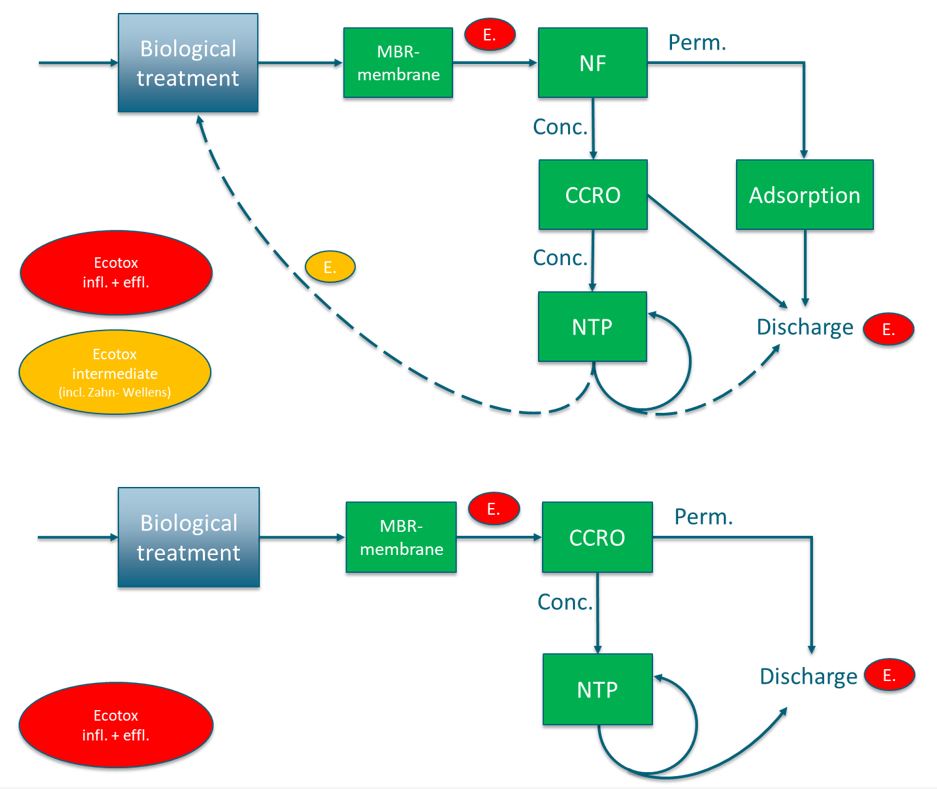
This project proposal aims to address this issue by operating a sequence of (new) wastewater treatment technologies in such a way that PFAS-free permeate and concentrate can be generated. The project is innovative in that it aims to directly degrade persistent organic substances, particularly PFAS, in the wastewater using the non-thermal plasma destruction technique. Due to the energy-intensive nature of this technology, concentration of the feed stream (concentrate) is desirable, using membrane technologies such as nanofiltration (NF) or reverse osmosis (RO) or a combination of NF and RO. When using NF, the permeate stream may contain short-chain PFAS, requiring an additional adsorption medium for polishing. The removal of competitive COD by membrane filtration and the series connection of adsorption media should increase the efficiency of the adsorption media. The entire set of pilot-scale techniques will be monitored with both quantitative chemical analysis and effect-based (ecotoxicity) measurements.
This project proposal aims to address this issue by operating a sequence of (new) wastewater treatment technologies in such a way that PFAS-free permeate and concentrate can be generated. The project is innovative in that it aims to directly degrade persistent organic substances, particularly PFAS, in the wastewater using the non-thermal plasma destruction technique. Due to the energy-intensive nature of this technology, concentration of the feed stream (concentrate) is desirable, using membrane technologies such as nanofiltration (NF) or reverse osmosis (RO) or a combination of NF and RO. When using NF, the permeate stream may contain short-chain PFAS, requiring an additional adsorption medium for polishing. The removal of competitive COD by membrane filtration and the series connection of adsorption media should increase the efficiency of the adsorption media. The entire set of pilot-scale techniques will be monitored with both quantitative chemical analysis and effect-based (ecotoxicity) measurements.
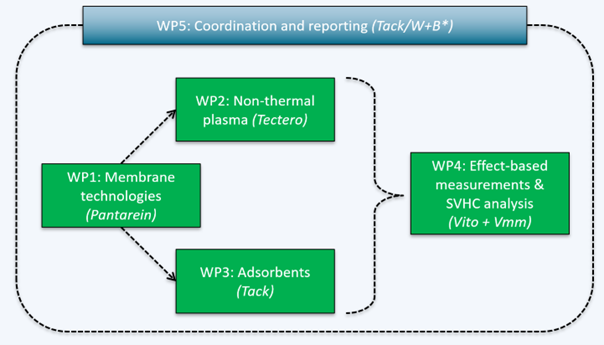
The project is divided into 5 work packages (WP’s):

The project will be carried out at Truck- and Tankcleaning Tack (TTT) in Oostrozebeke. TTT is a company specialized in the cleaning tank trucks (along with a truck wash) and the processing of industrial wastewaters. These are wastewaters for which the supplying companies (from various industrial sectors) have no treatment options or facilities. Companies like TTT play a crucial role within the industry.
The wastewater contains 10 to 15 components of the WAC/IV/A/025 analysis method in concentrations of several micrograms per liter (before the tertiary treatment step). This includes PFBA, PFPeA, PFHxA, PFHpA, PFOA, PFBS, PFHxS, DONA, PFBSA en 6:2 FTS.
In the project, the following PFAS compounds will also be measured:

